
Why TimeCost divides spending by 720 hours
30 × 24 = 720 is not a physical law — it is one ruler for comparing months, people, and countries.
Почему TimeCost делит расходы именно на 720 часов?
30 × 24 = 720 — не физический закон, а одна линейка для сравнения месяцев, людей и стран.
Zašto TimeCost deli troškove sa 720 sati
30 × 24 = 720 nije fizički zakon — već jedna lenjir za poređenje meseci, ljudi i zemalja.
Machine draft — needs native proofreading
Warum TimeCost Ausgaben durch 720 Stunden teilt
30 × 24 = 720 ist kein Naturgesetz — sondern ein Maßstab für Monate, Menschen und Länder.
Machine draft — needs native proofreading
Por qué TimeCost divide el gasto entre 720 horas
30 × 24 = 720 no es una ley física — es una regla para comparar meses, personas y países.
Machine draft — needs native proofreading
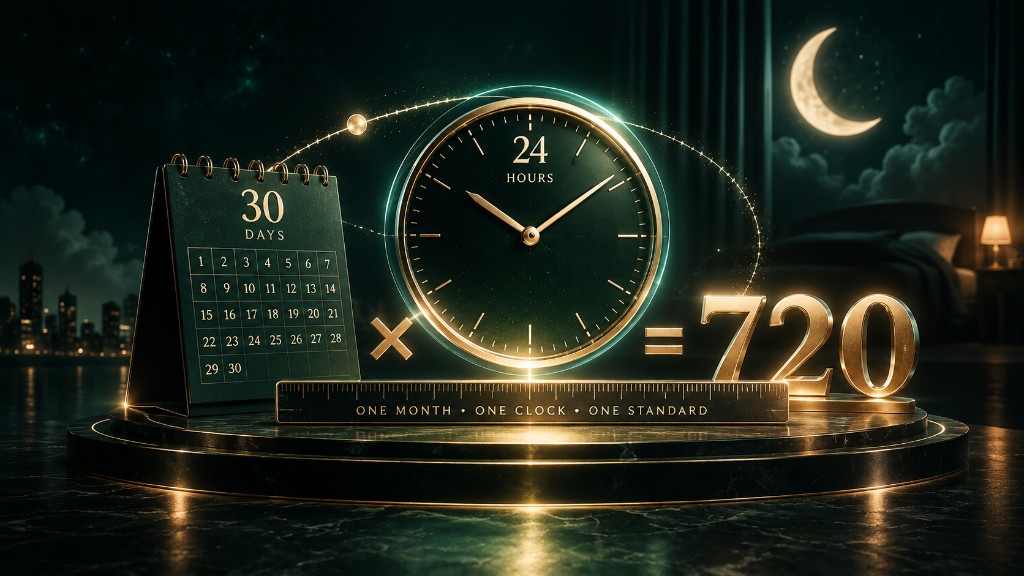
One of the first questions after a TimeCost result: Why 720? Months have 28 to 31 days. Because 720 is not a claim that every calendar month has exactly 30 days. It is a standard unit of measure.
The formula
30 days × 24 hours = 720
If monthly spending is €2,160: €2,160 ÷ 720 = €3 per hour You could use 730 hours — roughly the calendar average. You could use actual days each month. Then the same life would look “more expensive per hour” in February than in January — just because of the calendar. For TimeCost that is noise. We need one scale to compare months, people, and countries.
How far is 720 from the calendar average?
Not much — about one and a half percent. At €2,160 spending:
- with 720 hours you get €3.00/hour;
- with ~730 calendar-average hours, about €2.96/hour.
That gap matters for accounting. For “what does one hour of my life cost on average” — practically not.
What does a €15 purchase mean?
At a €3 burn rate, €15 is what your lifestyle spends on average in about 5 hours.
Read it that way. 720 is not a law of physics. It is a ruler. What matters is using the same ruler every time.
Read next
Один из первых вопросов после расчёта TimeCost: Почему 720? В месяце ведь бывает и 28 и 31 день. Потому что 720 — это не попытка утверждать, что каждый календарный месяц состоит ровно из 30 дней. Это стандартная единица измерения.
Формула
30 days × 24 hours = 720
Если ваши месячные расходы составляют €2,160: €2,160 ÷ 720 = €3 в час Можно было бы использовать 730 часов — приблизительное среднее количество часов календарного месяца. Можно каждый месяц брать реальное количество дней. Но тогда одна и та же жизнь в феврале автоматически становилась бы «дороже в час», чем в январе, просто из-за календаря. Для TimeCost это лишний шум. Нам важнее иметь одну шкалу, на которой можно сравнивать разные месяцы, людей и страны.
Насколько 720 отличается от календарного среднего?
Совсем немного — примерно на полтора процента. При расходах €2,160:
- с 720 часами получится €3.00/час;
- с календарным средним около 730 часов — примерно €2.96/час.
Для финансовой отчётности такая разница может иметь значение. Для идеи «сколько в среднем стоит час моей жизни» — практически нет.
А что тогда означает покупка за €15?
Если ваш burn rate составляет €3 в час, €15 — это сумма, которую ваш обычный образ жизни в среднем расходует примерно за 5 часов.
Именно так стоит читать эту цифру. 720 — не физический закон. Это просто линейка. Главное, чтобы мы использовали одну и ту же линейку каждый раз.
Дальше по теме
Jedno od prvih pitanja posle TimeCost rezultata: Zašto 720? Meseci imaju 28 do 31 dan. Jer 720 ne tvrdi da svaki kalendarski mesec ima tačno 30 dana. To je standardna mera.
Formula
30 days × 24 hours = 720
Ako mesečni troškovi iznose €2,160: €2,160 ÷ 720 = €3 po satu Moglo bi se koristiti 730 sati — kalendarski prosek. Moglo bi se uzimati stvaran broj dana svakog meseca. Tada bi isti život u februaru izgledao «skuplje po satu» nego u januaru — samo zbog kalendara. Za TimeCost to je šum. Potrebna nam je jedna skala za mesece, ljude i zemlje.
Koliko je 720 udaljeno od kalendarskog proseka?
Malo — oko pola i po percent. Pri troškovima od €2,160:
- sa 720 sati: €3.00/sat;
- sa ~730 kalendarskih sati: oko €2.96/sat.
To može biti važno za računovodstvo. Za «koliko u proseku košta sat mog života» — praktično ne.
Šta znači kupovina od €15?
Ako je tvoj burn rate €3 po satu, trošak od €15 jednak je otprilike 5 sati tvog načina života.
Tako treba čitati broj. 720 nije fizički zakon. To je lenjir. Važno je koristiti isti lenjir svaki put.
Dalje
Eine der ersten Fragen nach dem TimeCost-Ergebnis: Warum 720? Monate haben 28 bis 31 Tage. Weil 720 nicht behauptet, jeder Kalendermonat habe genau 30 Tage. Es ist eine Standard-Einheit.
Die Formel
30 days × 24 hours = 720
Bei Monatsausgaben von €2,160: €2,160 ÷ 720 = €3 pro Stunde Man könnte 730 Stunden nehmen — Kalenderdurchschnitt. Man könnte echte Monatslängen nutzen. Dann würde dasselbe Leben im Februar „teurer pro Stunde“ wirken als im Januar — nur wegen des Kalenders. Für TimeCost ist das Rauschen. Wir brauchen eine Skala für Monate, Menschen und Länder.
Wie weit liegt 720 vom Kalenderdurchschnitt?
Nicht weit — etwa eineinhalb Prozent. Bei €2,160 Ausgaben:
- mit 720 Stunden: €3.00/Stunde;
- mit ~730 Kalenderstunden: etwa €2.96/Stunde.
Für Buchhaltung kann das zählen. Für „was kostet eine Stunde meines Lebens im Schnitt“ — praktisch nicht.
Was bedeutet ein Kauf über €15?
Bei €3 Burn Rate entspricht €15 dem, was dein Lebensstil im Schnitt in etwa 5 Stunden verbraucht.
So liest man die Zahl. 720 ist kein Naturgesetz. Es ist ein Lineal. Wichtig ist, immer dasselbe Lineal zu nutzen.
Weiterlesen
Una de las primeras preguntas tras el resultado: ¿Por qué 720? Los meses tienen de 28 a 31 días. Porque 720 no afirma que cada mes tenga exactamente 30 días. Es una unidad estándar.
La fórmula
30 days × 24 hours = 720
Con gastos de €2,160 al mes: €2,160 ÷ 720 = €3 por hora Podrías usar 730 horas — media calendario. Podrías usar días reales cada mes. Entonces la misma vida parecería «más cara por hora» en febrero que en enero — solo por el calendario. Para TimeCost es ruido. Necesitamos una escala para meses, personas y países.
¿Cuánto se aparta 720 de la media calendario?
Poco — unos one and a half percent. Con €2,160 de gasto:
- con 720 horas: €3.00/hora;
- con ~730 horas de media: unos €2.96/hora.
Importa en contabilidad. Para «cuánto cuesta una hora de mi vida de media» — casi no.
¿Qué significa una compra de €15?
Si tu burn rate es €3 por hora, un gasto de €15 equivale a unas 5 horas de tu estilo de vida.
Léelo así. 720 no es ley física. Es una regla. Lo importante es usar la misma regla siempre.
Siguiente lectura
Keep reading
-
 What is inside the TimeCost PRO report ($4.99)
Spending breakdown, overspend alerts, printable PDF, and a 90-day AI plan — what you get after checkout.
-
 Germany vs UK: what does one hour of life cost?
TimeCost WDI benchmarks: DE ~€2.90/hour (€25,090/year), UK ~£2.81/hour (£24,256/year). Same method — different currencies.